
Flag of the Commonwealth of Australia
 
 
Christian based service movement warning about threats to rights and freedom irrespective of the label.
"All that is necessary for the triumph of evil is that good men do nothing"
Edmund Burke
Flag of the Commonwealth of Australia
 
 
.
.
.
.
.
   
Media
Media

On Target

11 February 2012 Thought for the Week:

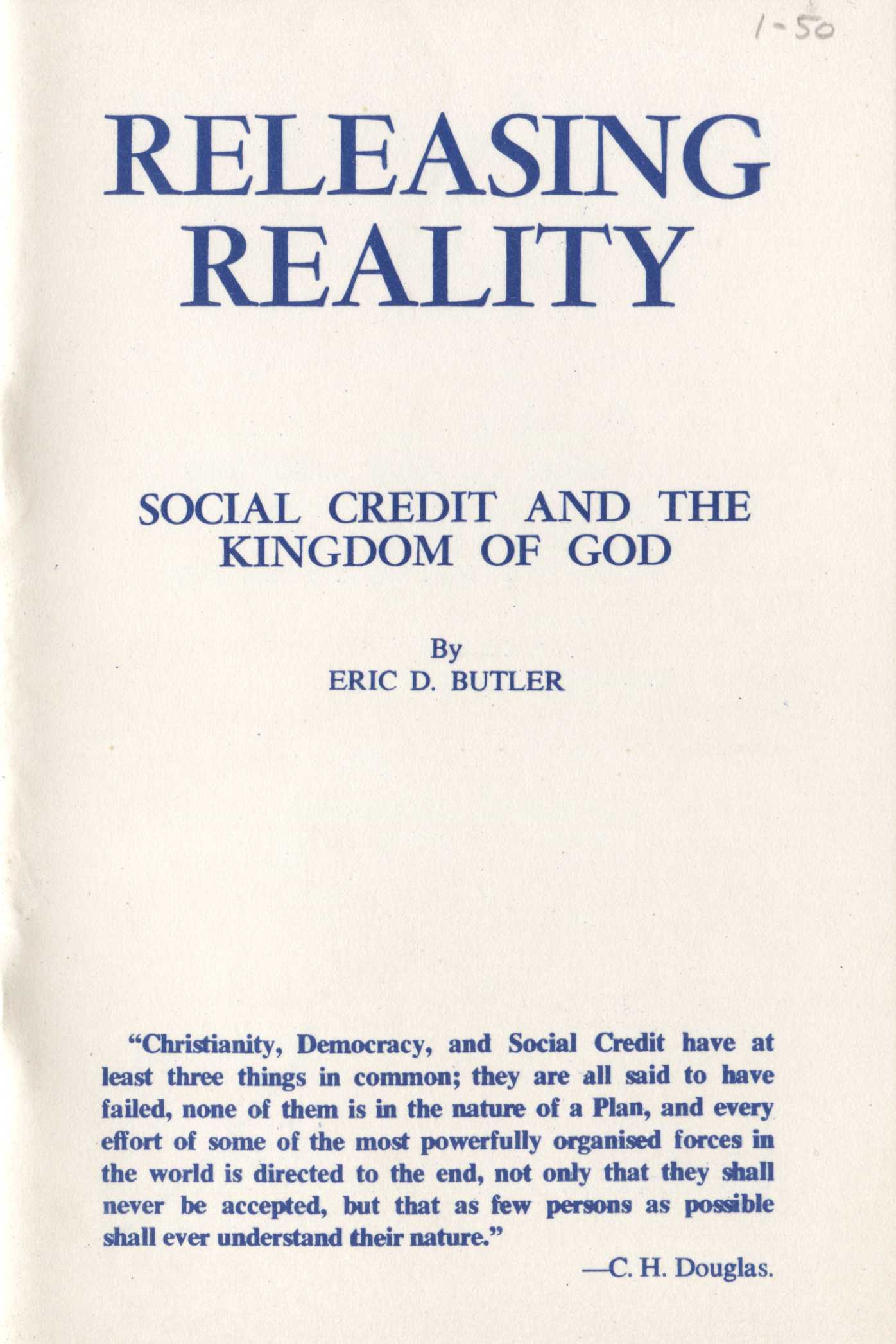
"Unlike orthodox party political activities, which encourage electors to be passive for three or more years, and then divide them into warring groups about different methods of implementing the same policies, Douglas insisted that democracy required that policy initiatives must come from the electors. Democracy was impossible unless electors accepted their personal responsibilities. (In) “The Approach to Reality”, Douglas said “…You must not send candidates to Parliament to be technicians. You must send candidates to Parliament to impress your will upon the technicians who already exist. That is the very essence of the problem"."

- - Eric D. Butler, in “Releasing Reality” 1979

A bit of their own Australia Day party-political-divisive-medicine?
“In extraordinary scenes, a visibly frightened Prime Minister was swept off her feet by security and lost a shoe as she was bundled into a car and whisked away from a ceremony at a Canberra restaurant for national emergency m
edal winners. The Opposition Leader was also pushed into the waiting car by security who feared the protest had gotten out of hand”.


OPPOSE RECOGNITION OF LOCAL GOVERNMENT IN THE CONSTITUTION

by Ian Wilson LL.B.
Dr. David Mitchell has written a brilliant essay “Referendum to Amend the Constitution to Recognise Local Government”. He soundly put the case that local government should not be recognised because in the Westminster system there are three distinct powers (legislative, executive, and judicial) and local government is purely a creature by delegation of power from state governments. The claim that local government is a third tier of government is false. The attempts to include local government in the Constitution previously have all failed. People have seen that such a change would advance centralisation and further diminish the powers of the States, which a centralist High Court has been cutting away at since its inception.

Further, as Dr. Mitchell concludes:
“The mere mention of local government in the Constitution might be sufficient to enable the Commonwealth Government to undermine the policies of State Governments of direct funding for local government to do its bidding”. Consequently, local government should not be recognised in the Australian Constitution. In the present climate, oppose all changes to the Australian Constitution, even to add a “,”.

Take the time to understand the “Spirit of Australia's Constitution and History” - Set of 5 DVDs by Dr. David Mitchell. Price $40.00 + $2.00 postage.
"Your Council The Target" by former Councillor Beavan O'Regan DVD: $12.00 posted.  


OUR FEET ARE SET UPON A ROAD WHOSE ONLY END IS WAR

James Reed and Chris Knight have written a review of Professor Steve Keen’s book “Debunking Economics: The Naked Emperor Dethroned” (below). They conclude their rather technical review by observing that Steve Keen, Professor of Economics and Finance at the University of Western Sydney, “mentions many other developments in economic alternatives, but does not mention C.H. Douglas and social credit”. They see this as a pity “because social credit would seem to provide just the philosophical framework he is seeking”.
In his BBC radio broadcast “The Causes of War: Is Our Financial System to Blame?” (1934) Clifford Douglas stressed the necessity of distinguishing between the motives and causes for wars, and, it would seem, that either our world leaders had better do just that, quick-smart, or the world as we know it, is in for unimaginable disasters.

Douglas wrote: The technical definition of war is “any action taken to impose your will upon an enemy or to prevent him from imposing his will upon you.” It will be recognised at once that this definition of war makes the motive rather than the method the important matter to consider. More energy is devoted at the present time to the endeavour to modify the methods of war than to removing the motives for war.

If we recognise this, we shall be in a better position to realise that we are never at peace – that only the form of war changes. Military wars are waged by nations, a statement which is the basis for the somewhat naïve and, I think certainly erroneous idea, that you would abolish war if you abolished nations. This is much like saying you would abolish rate-paying if you abolished Urban District Councils. You do not dispose of a problem by enlarging its boundaries, and, if I am not mistaken, the seeds of war are in every village. We can get a glimpse of the main causes of war if we consider the problem of statesmen, who are expected to guide the destinies of nations. I suppose most statesmen at the present time would agree that their primary problem is to increase employment, and to induce trade prosperity for their own nationals, and there are few of them who would not add that the shortest way to achieve this would be to capture foreign markets.

Once this, the common theory of international trade, is assumed, we have set our feet upon a road whose only end is war. The use of the word “capture” indicates the desire to take away from some other country, something with which it being unable, also, to be prosperous without general employment does not desire to part. That is endeavouring to impose your will upon an adversary and is economic war, and economic war has always resulted in military war, and probably always will.

The so-called psychological causes of war are the response of human nature to irritations which can be traced to this cause either directly or indirectly. To say that all men will fight if sufficiently irritated seems to me to be an argument against irritating them, rather than against human nature. It is not the irritation which causes the economic war, it is the economic war which causes the irritation. Military war is an intensification of economic war, and differs only in method and not in principle…

So long, then, as we are prepared to agree, firstly, that the removal of industrial unemployment is the primary object of statesmanship, and secondly, that the capture of foreign markets is the shortest path to the attainment of this objective, we have the primary economic irritant to military war always with us, and, moreover, we have it in an accelerating rate of growth, because production is expanding through the use of power machinery, and undeveloped markets are contracting. Any village which has two grocery shops, each competing for an insufficient, and decreasing, amount of business, while continually enlarging its premises, is a working demonstration of the economic causes of war – it is, in fact, itself at war by economic methods.

I do not believe that it is sensible to lecture the public of any or all of the nations on either the wickedness or the horrors of war, or to ask for goodwill to abolish military war or the trade in armaments, so long as it remains true that, if one of the village grocers captures the whole of the other grocer’s business, the second grocer and his employers will suffer. Or if it remains true that if one nation captures the whole of another nation’s trade the population of the second nation will be unemployed, and being unemployed they will suffer also.

It is poverty and economic insecurity which submits human nature to the greatest strain, a statement which is easily provable by comparing suicide statistics with bankruptcy statistics and business depression. Suicides are less in numbers during wars, not because people like wars, but because there is more money about. Suicides are less in number during trade booms for the same reason. To know, therefore, whether war is inevitable, we have to know whether, firstly, there is enough real wealth available to keep the whole population in comfort without the whole of the population being employed, and, secondly, if this is so, what is it that prevents this wealth from being distributed.

Further reading …. : Or listening


WHAT ABOUT A ‘MIDDLECLASS PITCHFORK REVOLT”?

Veterans Today report on what is happening in Sicily – and, they say, not a word from the western media! “Sicily Was Under Complete Blockade by Pitchfork Movement, Triggered by 40% Gas Tax Hike”. On January 16th, middle class Sicilians began a popular uprising appropriately called the ‘Pitchfork Movement’…’Movimento Dei Forconi’.

There are shades of the Occupy movement within it, but the core is not dissatisfied unemployed youth with no property or businesses to lose. They are middle aged and older. They know that what they have left has been targeted by their own elites to bear the economic pain. The other difference is size. Sicily’s five million people, their grass roots people, have occupied themselves…. it started on the 16th January and took two days to shut the island down, nothing going in or out. That was almost two weeks ago.

Can you image the Occupy Wall Street people having shut Manhattan down for two weeks with no European coverage? Sure, it’s Sicily and not Manhattan…but it’s big, 25,000 sq km. What could corporate media possibly be afraid of? Well grab your seats, and here it is: The arrest of all corrupt politicians; Reduction in the number of Parliamentarians; Removal of the provincial bureaucracy (local crooks), as most of these politicians have been there for over forty years; Drastic cuts in the salaries and privileges of Parliamentarians and Senators; Restricting politicians to only two terms in office…” Further reading here…


DEBUNKING ECONOMICS : THE NAKED EMPEROR DETHRONED?

The Poverty of Economics: a review of Steve Keen’s book by James Reed and Chris Knight:
Steve Keen, Professor of Economics and Finance at the University of Western Sydney has published a revised and expanded version of his book “Debunking Economics” (Zen Books, London 2011). The 2001 edition of the book had the subtitle “The Naked Emperor of the Social Sciences” (Pluto Press). The revised edition has the subtitle “The Naked Emperor Dethroned?”

Keen attempts in both books to present a comprehensive critique of neoclassical or orthodox economics, as standardly taught at Anglo-American schools and universities. The position is captured in iconic text books such as that by Paul A. Samuelson, which now is co-written with W.D. Nordhaus, “Microeconomics” (McGraw-Hill Irwin, New York, 2010). Neoclassical economics is not explicitly defined by Keen, but is implicitly defined by the subject of his critique. Neoclassical economics has a positivist methodology, rigorously distinguishing between fact and value (i.e., pure and positive economics) and between theories and observations. The text books today tend not to mention this as these distinctions have been refuted in the philosophy of science. Further, neoclassicalism still maintains a hedonistic utilitarian philosophy of human nature: Humans strive to maximise “utility” or happiness.

Microeconomics, the essence dealing with personal consumption and demand theory has been theoretically grounded on “the calculus of hedonism”. The downward-sloping demand curve is standardly justified on the basis of indifference curves which, allegedly, represent the preferences of utility-maxmising consumers. The indifference curve is in turn based upon four axioms:
Completeness (a consumer can decide between different combinations of goods): transitivity, if good combination A is preferred to B, and B to C, then A is preferred to C; non-satiation, more is preferred to less, and convexity, that indifference curves are convex (i.e., like a “slippery dip”) because of diminishing marginal utility, with the consumer’s marginal utility decreasing with additional units.

Now the problem for neoclassical demand theory is that there are counter examples to the axioms, and more generally that a wealth of psychological studies have shown that people do not obey these axioms. Keen mentions a little of this literature and as impressive as his book is we are aware of a much more comprehensive critical literature, although much of it is beyond our competence. Apart from the falsity of the axioms Gorman (W.M. Gorman, “Community Preference Fields”, Econometrica, Vol21, 1953, pp.63-80) has shown that demand curves can take any shape at all except ones that double back on themselves.

The technical mathematical economics literature has established that the law of demand can only apply to the general market demand curve if (1) all commodities are neutral goods i.e., consumption ratios remain the same regardless of changes in income and (2) all consumers have identical tastes. Keen, through his book, outlines these results from mathematical economics, then shows that they constitute a reductio ad absurdum of neoclassical economics.

Hence in Chapter 3, “The Calculus of Hedonism”, he concludes that market demand curves can have any shape at all (except doubling back). But he could have gone further and from the refutations of the utility axioms concluded that the demand curve, even for an individual does not exist! A curve has a non-denumerable infinity of points (i.e., the same number as the set of real numbers) and it is absurd to suppose that consumer preference can be infinitely distinguishing.

In Chapter 4, “Size Does Matter”, Keen attempts to show that supply curves do not exist, by showing that the supply curve’s existence requires perfect competition. Chapter 5 “The Price of Everything and the Value of Nothing” continues his attack on the theory of supply, attacking the so-called law of diminishing marginal returns. Chapter 6 attacks neoclassical labour market theory and Chapter 7 looks at the “Cambridge Contravenes in Capital”, where a vast literature showed that neoclassical capital theory is logically inconsistent. Chapters 8 and 9 critique neoclassical methodology and show that assumptions do matter.

Perhaps the most important part of Keen’s work has been with the crises of Capitalism and financial instabilities. In the early part of his book he points out that he and a small group of economic rebels predicted the Global Financial Crisis (GFC). Chapters 13-18 deals with this issue and alternative economics and is the most important part of his book. Keen points out that the neoclassical economics, unlike post-Keynesian and Austrian economics, neglects the important role of credit and money in their model of the economy. Neoclassical economics is largely concerned with equilibrium so the idea of a fundamental economic crisis is something outside of their paradigm.

Keen however has built on Hyman Minsky’s Financial Instability Hypothesis and has developed a general mathematical model of financial crises. The model involves nonlinear mathematics but essentially debt induces breakdown as the debt-to-output ratio ratchets up over time. (p.333) The debt rises during a boom, then peaks and falls in a slump but before the debt-to-output ratio reaches the old value a new boom begins this process again. Before the economic breakdown there would be large fluctuations in employment and output. As the debt ratio rose “the volatility started to rise again, until there was one last extreme cycle in which the debt level was so high that debt repayments overwhelmed the capacity of capitalists to pay”. (pp.333-334) The economy then goes into a “Great Recession”.

Keen plotted Australia’s private debt to GDP level in December 2005 and observed that it had increased over fivefold since the mid-1960s. The US debt ratio also had an exponential rate of expansion, as did most OECD countries. Keen had been working on a book entitled “Finance and Economic Breakdown” (now due to be published in 2013), but he shelved this and began warning policy makers and the general public about the coming economic crisis.

He also attempted to improve his model of debt in a capitalist society. To do this he returned to the great political economist J.A. Schumpeter’s “The Theory of Economic Development” (1931). Schumpeter rejected the conventional model of the operation of the banking sector, that credit is created when a person’s savings are transferred to another person as a loan, and held that credit is created by the banks “out of nothing”. Keen says: “The fact that these promises by banks to pay are accepted as money in their own right is what makes it possible for banks to expand the supply simply by creating a new loan. The new loan creates a debt between the borrower and the bank, and it also creates additional spending power”. (p.370) Thus, banks create money “out of nothing”

Keen says but the empirical evidence shows that “these control mechanisms have failed: the banks create as much new money as they can get away with, because fundamentally, banks profit by creating credit”. (p.370) Banks profit by creating as much debt as possible, which, Keen notes is “Why it is unwise to leave the level of debt creation up to the financial sector”. (p.372) But when banks no longer are willing to lend, a debt crisis follows. Keen, of course, has much more to say by way of technicalities than this.

The book concludes with a look at alternate economic theories. Austrian economics (Menger, Hayek, von Mises) has the merit that it recognises disequilibrium but accepts some neoclassical doctrines such as the marginal theory of income distribution, which Keen shows is flawed. Post-Keynesian economic theory and econophysics lack a historical dimension and evolutionary economics faces various theoretical difficulties, especially in empirical operationalising its concepts drawn from neo-Darwinian evolutionary theory.

Keen mentions many other developments in economic alternatives, but does not mention C.H. Douglas and social credit. This is a pity because social credit would seem to provide just the philosophical framework he is seeking. Perhaps a fruitful dialogue can begin between social crediters and Professor Keen and he may choose to put his keen intellect towards defending social credit.  

BREAKING NEW GROUND:
Dr. Frances Hutchinson’s presentations at the 2011 South Australian Seminar have proven to be just so timely; she puts in layman’s language just what has happened in the academic world of Economics; she explores the past in order to grasp where we are in the present, thus opening our minds to seek alternatives for a better future.
Dr. Hutchinson explains the one economic model that is taught in most universities leads on to a pyramidal social structure with 85% of the people becoming simply wage-slaves.
Bill Carey of ‘Bankwatch’ presents a paper outlining just what he and the late Jim Cronin achieved in their battle against the banks for the drought-stricken farmers in the late 1980s-early-1990s.
And pioneer organic dairy farmer Harry Dreckow tells his story of “Going Organic”.

DVD-1, Dr. Hutchinson and Bill Carey $15.00 each:
DVD-2 Dr. Hutchinson and Harry Dreckow. Two DVDs for $25.00.

Coming shortly DVD-3: A further weekend featuring Dr. Hutchinson was held in a private home and the two DVDs will be shortly available. Dr. Hutchinson aimed these talks at the younger generation and the other two guest speakers were Narrah Zollo showing what can be done with weeds from our garden and simple nutritious ‘nibbles’. Bishop Stanley Goldsworthy of the Anglican Church spoke on the importance of ‘making the Word flesh’.

“Making a Difference: Pastor Chris Field and his son Topher Field:
“Taking a Stand”: Pastor Chris Field was evicted from his home twice, not for refusing to pay his mortgage, but daring to ask who actually held the legal mortgage document to his home. He wanted to know where his mortgage payments were going.
The key point about all of Pastor Field’s queries was that in the light of the Derivatives Scam he wanted to know was his Mortgage Deed still held by the Macquarie Bank or on-sold to another institution?
"Communication: Making the Penny Drop": Topher Field's topic came under the heading of the importance of communicating with those of his younger generation.
Bruce Ingles, a veteran League supporter, enjoyed 'Topher's' presentation so much he thought it was 'the best seminar the League had ever held'!

Special Offer: Including the National Seminar DVD featuring Pastor Chris Field and his son Topher, “Making a Difference” ($15.00 single DVD) there will be five DVDs available for the special bulk price of $60.00.
Doug Holmes says he will throw in the booklets "Bankwatch"; "A Small Farmer Replies" and the revised version of the Social Dynamics DVD as a generous bonus.

Order from the Heritage Bookshops of Melbourne and Adelaide and/or Veritas online


WALLACE KLINCK ON SOCIAL CREDIT PHILOSOPHY AND DEBT FINANCE

We live in a perverted political system which alleges scarcity through false and restrictive financial accountancy. This results in real poverty and insecurity, in the midst of actual abundance with all the social dysfunction that might be expected from such circumstances. Social Credit policy is to establish a proper relationship between financial accountancy and the realities of production, distribution and consumption. Douglas was quite emphatic in criticizing those who would transfer the cause of our problems from our defective financial system to an alleged innate defect in human nature. Obviously, if we take the position that all our problems are due to innate evil in the human personality then quite obvious nothing effective or enduring ever can be done to better our economic and social conditions.

Nothing could be more effective in sabotaging the entire Social Credit cause than to attribute our problems fundamentally to human nature, per se. Douglas was for very good reasons not especially enamoured of the so-called Doctrine of Original Sin. Certainly, as mortals we err. Let's wake up and minimize the erring. We waste endless time and energy in arguing incessantly about issues which were clarified some ninety years ago when we should be advancing Social Credit philosophy and policy in a focussed and concentrated manner to bring irresistible pressure upon our public representatives and policy makers.

Look, we humans are as God created us. We are what we are, and, quite reasonably or expectedly we react negatively to abnormal and unnatural conditions thrust upon us. The instinct for self-preservation is perverted when we turn to self-centred and selfish isolation as a means to survive in what appears falsely through the glass of orthodox financial policy to be a brutal world.

Genuine Social Credit ("social credit") is something that arises and effloresces from constructive association and not from an atavistic retreat into an anti-social mode of siege and blind self-survival. This move back into barbarism is caused by lack of knowledge, understanding and Faith in the existence and positive potential of association much less in association itself.

This attitude is, of course, a fatal delusion which can lead to nothing constructive in our lives. Faith alone can move mountains. Social Credit policy is to lift the veil of financial ignorance and so break the bonds of financial hegemony, thus truly to liberate mankind. We want to allow human life to exist and prosper within the context of natural, not un-natural, law. Only in such an environment can the best attributes of man be expected to emerge. If someone wants to criticize the handiwork of God then that person is so entitled. Personally, I would be very reluctant to engage in such a bold rebellion against the natural order. Not a very humble, wise or fruitful approach in my opinion. Let us endeavour to live harmoniously within the natural order--not in opposition to it. “The Fool sayeth in his heart that there is no God”.

Our false system of legerdemain is all-prevalent in human affairs and therefore deserves attention as the primary influence in setting us humans against the natural order. Our primary task is to restore honesty and accuracy to the abstract mechanism which in modern society we use to represent human activity. Let us not succumb to the incantations of the witch-doctors.

If we are endlessly to debate and agonize over the fundamental nature of mankind we are engaging in a will-o-the-wisp that will lead us to nowhere. Let us strive to provide an economic and social environment wherein man has the opportunity to function in a natural manner. This would be to elevate realism above abstractionism.

By including himself among the "greedy" the individual cannot evade the fact that he is also so condemning all others. Surely the destiny of mankind lies upon a more lofty level. Civilized people do not want a "quick buck" - they want a cultured, spiritual and ethical life - something increasingly impossible of attainment under the existing Hegemony of Debt Finance.  


SO, WHAT EXACTLY IS A TECHNOCRAT ANYWAY?

The following excerpt is from an article found on Al jazeera’s website and is by Joshua A. Tucker, a Professor of Politics at New York University: What is a 'technocrat'? And why are technocratic governments all the rage these days in Europe? Greek Prime Minister and 'technocrat' Lucas Papademos was previously an economist and banker [Reuters] The sky is falling! The Euro is collapsing! What can we do? Look, up in the sky: it's a bird! it's a plane, it's... technocratic government!

Destined to save small and large European countries alike, we have now been graced with the sudden appearance of technocratic government as a deus ex machina in Italy, where economist Mario Monti has been named prime minister and Greece, where economist Lucas Papademos has been named prime minister. As the hero of our day - the technocratic government - is largely unknown to many of our readers, we summon the spirit of Greek drama for a brief dialogue on technocratic government:

Q: What's a technocratic government?
A: To answer this question we first need to be clear about how governments are formed in parliamentary systems, which are what we find in both Greece and Italy (and most advanced industrialised democracies outside of the United States). Unlike in presidential systems - where the president is largely free to choose the ministers he or she wants in the cabinet - in a parliamentary system the government must be approved by the parliament. Often this will require the agreement of more than one political party, resulting in a coalition of parties to support the government. As part of this "coalition agreement", the heads of ministries (or what are called Secretaries in the United States) are allocated to the different parties, who place representatives from their parties as the heads of their respective ministries. Moreover, the parties agree on a "Prime Minister" to head the government, usually but not always from the largest party in the coalition. Most of the time, the identity of this "Prime Minister" - conditional on election results - is known during the election campaign.

Q: Ok, so what's a technocratic government?
A: Technically (no pun intended), a technocratic government is one in which the ministers are not career politicians; in fact, in some cases they may not even be members of political parties at all. They are instead supposed to be "experts" in the fields of their respective ministries. So the classic example is that the Finance Minister would be someone with an academic background in economics who had worked for years at the IMF, but has not previously run for elective office or been heavily involved in election campaigns.

Related Snippet: . “Future Fund playing it safe 31 January, 2012:
Australia's Future Fund holds around $73 billion. It was created to fund public sector retirement liabilities. Its latest quarterly update reveals it's moving away from Australian shares and into cash, and more alternative asset classes. Industry professionals say it's a conservative move. Economists argue it's a response to increasingly unpredictable financial markets.


GREECE REFUSES GERMAN CONTROL

Andrew Bolt – Tuesday,31 January, 2012:
Greeks would rather be broke than have Greece become a German colony: Greece has reacted furiously to a German proposal that a European Union budget commissioner with oversight of its economy be installed in Athens after mounting speculation that international lenders will have to stump up yet more money for the country…
The proposal, in a leaked document, argued for the creation of a commissioner with veto powers over the Greek budget, saying Athens’ inability to meet fiscal targets had made the post a precondition of further rescue funds from its ‘’troika’’ of creditors - the EU, International Monetary Fund and European Central Bank.
So do international institutions assume a right to infringe on democratic principles, and in ways we’d have thought unimaginable - the stuff of crackpot conspiracy theories - only a couple of decades ago…”


BASIC FUND

We would ask more supporters to please get behind the Basic Fund appeal. The target is the same as it has been for many years $60,000. The figure has reached $22,315:00. We need a really good supportive push along the way. Thank you. 


HERITAGE BOOKSHOP SERVICES

Please note: Prices now quoted for books do not include postage and handling charges, and will be subject to change. Postage and Handling charges for Book Orders will be as follows: + 20% on orders less than $50.00 : + 12.5% on orders $51.00 to $100.00 : Orders over $100.00 to be negotiated : Minimum order $2.00. Cheques/Money Orders made out to 'Heritage Bookshop' please.

Heritage BookShop Service carries an excellent range of DVDs at affordable prices. Ring or write Doug and Jean Holmes and ask them to send you a list related to the issues/subjects of your choice. Phone 08 8258 7005

IMPORTANT DVDs NOW AVAILABLE
South Australia 2011 State Seminar: * * “Breaking New Ground” * *

The Seminar featured guest speakers Dr. Frances Hutchinson, Chair of the UK Social Credit Secretariat, Mr. Bill Carey of Bankwatch fame from Streaky Bay, and pioneer organic-farmer Mr. Harry Dreckow of Mylor, South Australia.

There are two DVDs of the State Seminar “Breaking New Ground”, $15.00 each and/or $25.00 for two DVDs.

* DVD No 1: Dr. Frances Hutchinson presents two papers – “The Writing of Understanding the Financial System” and “Try It on a Map” with Bill Carey presenting his paper “Australia Latecomer in Present World Drama”.

* DVD No 2: Dr. Hutchinson presents two more papers “Finance and the Threefold Commonwealth” and “In Praise of Idleness” with pioneer organic-farmer Harry Dreckow, “We Went the Organic Way”.

* * Annual National Seminar: "Making a Difference" * *

At the National Seminar held in Bendigo Victoria, guest speakers were Pastor Chris Field and his son ‘Topher’. Both speakers are on the one DVD - $15.00 for single DVD.

“Taking a Stand”: Pastor Chris Field was evicted from his home twice, not for refusing to pay his mortgage, but daring to ask who actually held the legal mortgage document to his home. He wanted to know where his mortgage payments were going. The key point about all of Pastor Field’s queries was that in the light of the Derivatives Scam he wanted to know was his Mortgage Deed still held by the Macquarie Bank or on-sold to another institution?
"Communication: Making the Penny Drop": Topher Field's topic came under the heading of the importance of communicating with those of his younger generation. Bruce Ingles, a veteran League supporter, enjoyed 'Topher's' presentation so much he thought it was 'the best seminar the League had ever held'!

Shortly Available: A further weekend featuring Dr. Hutchinson was held in a private home and the two DVDs will be shortly available. Dr. Hutchinson aimed these talks at the younger generation and the other two guest speakers were Narrah Zollo showing what can be done with weeds from our garden and simple nutritious ‘nibbles’. Bishop Stanley Goldsworthy of the Anglican Church spoke on the importance of ‘making the Word flesh’.

Altogether there will be five DVDs available and the special bulk price will be $60.00. Doug Holmes says he will throw in the booklets "Bankwatch"; "A Small Farmer Replies" and the revised version of the Social Dynamics DVD as a generous bonus.
Order from the Heritage Bookshops of Melbourne and Adelaide and/or Veritas online.

BOOKS:
“Grain Handling: The Way it Was” by the late Jim Cronin:

Older League supporters will most certainly remember the late Jim Cronin who passed away in 2009. Jim’s ties with the League of Rights go back a long way and he is especially remembered for his Bankwatch work with fellow farmer and friend Bill Carey in the late 1980s.
Whilst sorting out his belongings, Jim’s brother Pat and nephew Brent, along with second cousin Ian Rodgers, came across a series of recordings and notes on grain handling and lumping that Jim had previously made, intending to publish in book form at some later date. Pat and Ian took on that task – and so “Grain Handling – the way it was!” was published in September 2011. When launched at the centenary of the Cummins Show in October 2011 supplies sold out. Ian Rodgers saw that the strong interest in the book was because it was the only account of the State’s grain handling history. “It is a real part of South Australia’s agricultural history,” he observed. Price $20.00 + postage.

“Social Credit: Some Questions Answered” by Frances Hutchinson. $9.00 + postage.

“The Political Economy of Social Credit & Guild Socialism” by Frances Hutchinson and Brian Burkitt. Price $35.00 + postage. William Krehm of COMER has this to say about the book: “The contribution of Douglas-Orage to the incorporation of the non-market sectors of the economy – health, education, social security, the environment – is crucial. The power grab of the banking system that Douglas and his associates identified almost a century ago has come into a lethal flowering. In the long-overdue reassessment of what passes as economic science, their ideas will require careful attention. The Hutchinson-Burkitt book is mandatory for preparing ourselves for the task.”

The Wandering Who? Review by Peter Ewer:
Each week I saw Gilad Atzmon’s “The Wandering Who? A Study of Jewish Identity Politics advertised on this site - and have now read it. For everybody interested in the Middle East situation, this is a must-read. Written by a talented, sensitive and artistic Jew, this clearly written book explores the meaning of Jewish identity, because “Israel is the Jewish State… largely supported by world Jewry institutionally, financially and spiritually”. (p.15)
Through examining literature, philosophy and politics, Atzmon conducts a destruction of the very idea of Jewishness as a socio-ontologic essence. He speaks about how a vast array of Jewish groups hated him and he remarks that in a way he has united Jewry! Atzmon deconstructs anti-Semitism and the “dialectic of negation” (p.58).
His critique is punctured by a sharp wit and clever verbal jokes. I dare not even summarise what Altzmon says about the Holocaust. It is one of the best books I have read in recent times. The Tide Has Changed. Price $23.00 + postage.

“Resurrection or Retreat” by D.J. Pinwill: ‘A comparison of World Religions and their Consequences’ (100pp) What we believe will influence what we become. Different religions generate distinctly different civilizations – each with unique laws, cultures and lifestyles. This book examines the dominant world religions and compares them with Christianity. Readable and very relevant for today. $10 00 plus $2.00 postage

“Harmony: A New Way of Looking at Our World” by Prince Charles: Price $40.00 + $10.00 postage.
A beautifully presented book with exquisite photographs of the natural world and also a book proposing a powerful theme : humanity has lost its way. Prince Charles compares our plight to someone who has lost their way, needs to go back, retrace their steps and see where they went wrong. We need to do so too.
In the name of ‘modernism’ our world has been devastated. Modernisn is more than just a movement in art and architecture; it is the philosophy of de-humanised industrialism, materialism and science worship that has led to our experience of the loss of the perception of the interconnectedness of nature.
Chapter 2 - “Nature” - gives a highly readable account of the environmental crisis, and Prince Charles soberly notes that the monocultures of the world’s farmlands are constituting something of a “suicide belt” (p.63) open to destruction by climate change and disease. What then is to be done? Prince Charles proposes that we need to regain “tradition” and the wisdom of the past, a proposal made by many conservative thinkers. However, this is not merely cultural, but is profoundly ecological, where we need to come to understand the rhythms of nature and the ebbs and flows of life. This regaining of our place in the cosmos involves regaining our lost experience of the interconnectedness of nature and re-unifying soil and soul. (p.190) Human health is shown to be intimately connected to living in a healthy environment. (p.224) “Everything is bound to all else; causes are linked to effects and mindful of a unity that underlies the apparent diversity in the world. (p.312)
Harmony shows that Prince Charles is a leading ecological thinker. As the “people’s prince” he has written a highly readable book which you will not be able to put down. Leave it on your coffee table and dip into, again and again, enjoying the prose and photographs.
You deserve to treat yourself! God save the Queen and God Save Our Future King!

“The Mind Game” by Phillip Day: “The Mind Game” it must be said, has been my most extraordinary and challenging project to date, writes Phillip Day. I believe, after you have finished reading this book, that you also will agree that there are no greater or more important issues facing us as a civilisation than those under discussion within these pages.
The 18th and 19th centuries brought with them more than just the technical allure of an industrial revolution. Man himself became restless for a spiritual as well as a physical change in the way he had traditionally regarded himself and his place in the cosmos. New belief systems emerged, such as evolution, psychology, psychiatry and the mental health and hygiene movements. Their impacts on our future society were to be fundamental, far-reaching and ultimately tragic. Price $35.00 + postage.

“The Development of World Dominion” by C.H. Douglas. In the foreword to C.H. Douglas’ 1967 published notes, Tudor Jones wrote of the deluge of propaganda directed toward us all by the twin abstractions of “Science” and “The State”. Price: $5.00 + postage.

“The Brief for the Prosecution” by C.H. Douglas. Douglas saw war was exalted into a ‘cause’ instead of a symptom of an even greater evil. Modern warfare is the pursuit of a diabolical policy - a policy by other means towards a diabolical end. Hard copy $6.00 + postage.

“The Big Idea” by C.H. Douglas. Subsequent events have merely confirmed the facts exposed in this book. $5.50 + postage

“Thine is the Kingdom” by Ralph Laslett Duck. One of the earlier pioneers in the study of health and soil, and the role micro fauna and flora play. Price: $6.50 + postage

“ABC’s of Disease” by Philip Day. Price: $35.00 + postage.

Important reading on the ‘Money Question’

“The Money Trick” by Institute of Economic Democracy. $10.00 + postage.

“Why I Fight” by Jack Lang. $28.00 + postage.“For many years I have wondered how Adolf Hitler, in about 7 years, financed ruined Germany of the early thirties to build the amazing fighting machine that became Nazi Germany. Similarly, I have long wondered about the dismissal of the N.S.W. Lang Government due to its refusal to accept “The Premiers' Plan” that resulted in our Great Depression of the early thirties. "Jack" Lang's book provides remarkable insights, in particular, the destruction of the peoples' bank, the Commonwealth Bank of Australia, and its privatisation,” writes Peter Davis, former Port Lincoln mayor, after reading Jack Lang’s book. Jack Lang, a brave New South Wales premier who took on the banks.

“The Story of the Commonwealth Bank” by D.J. Amos, F.C.I.S. $10.00 + postage.

“Finance and Natural Law” by A.A. Chresby & J.D. Malan. Price $2.00 + postage....

“Social Credit: Some Questions Answered” by Frances Hutchinson. $9.00 + postage.

“The Political Economy of Social Credit & Guild Socialism” by Frances Hutchinson and Brian Burkitt. Price $35.00 + postage. William Krehm of COMER has this to say about the book: “The contribution of Douglas-Orage to the incorporation of the non-market sectors of the economy – health, education, social security, the environment – is crucial.
The power grab of the banking system that Douglas and his associates identified almost a century ago has come into a lethal flowering. In the long-overdue reassessment of what passes as economic science, their ideas will require careful attention. The Hutchinson-Burkitt book is mandatory for preparing ourselves for the task.”

“Understanding the Financial System: Social Credit Rediscovered” by Frances Hutchinson. This is a major work which should be in everybody’s library, $35.00 plus postage. Frances Hutchinson has drawn on the writings of key twentieth-century social thinkers, including C.H. Douglas, Rudolf Steiner and Thorstein Veblen, moving beyond negative critiques of global corporatism to suggest a transformation in our understanding of the relationship between finance, and the three spheres of society; the cultural, the political and the economic.

“The Politics of Money: Towards Sustainability and Economic Democracy” by Frances Hutchinson, Mary Mellor and Wendy Olsen. Price $35.00 plus postage. On the whole, classical and radical economists have marginalised the role of money, most particularly the role of credit, in driving the machinery of accumulation and exclusion. Although critiques of capitalism from Marxist, feminist, ecological and many other perspectives abound, “The Politics of Money” is unique in gathering the strengths of these differing critiques into a coherent whole. Frances Hutchinson is a research fellow at the University of Bradford. Mary Mellor is a professor in the School of Arts and Social Sciences at the University of Northumbria at Newcastle and Chair of the Sustainable Cities Research Institute. Wendy Olsen does research and lecturing in economics and development at the University of Manchester.

“What Everybody Really Wants to Know About Money” by Frances Hutchinson. $35 plus postage.
Money makes the world go round – but in ever diminishing circles. It’s the driving force behind most of the world’s problems. We all use money every day but we don’t understand where it comes from, who creates it, and most importantly, why. Frances shows why this situation has arisen, and explains many of the basic errors of orthodox economics.

“The Controversy of Zion” by Douglas Reed. Price $30.00 plus postage.
Many are led to believe that Christianity stems from Judaism and this idea has been carefully fostered, even by those behind the pulpits. But is it truly so? In 1978 Douglas Reed’s book “The Controversy of Zion” challenged that idea and set forth historical records and events as proof of his claim. Many Christians found it very difficult to accept what Reed wrote. I well remember one dear Christian lady who was a stalwart of the League of Rights being deeply offended by “The Controversy of Zion” and told me so in no uncertain terms.
The real issue which set up violent antagonism between the Founder of Christianity and the Pharisees was made much clearer by Reed - religious information and interpretation acquired an extra dimension of interest and importance when set in a proper relationship with historical developments from the Babylonian Captivity and onwards to modern times.

“Jewish History, Jewish Religion: The Weight of Three Thousand years” by Israel Shahak with forewords by Gore Vidal and Edward Said. Price $22.00 plus postage. Gore Vidal said: “I shall not rehearse the wars and alarms of that unhappy region. But I will say that the hasty invention of Israel has poisoned the political and intellectual life of the USA. Israel’s unlikely patron.”

“The Invention of the Jewish People” by Shlomo Sand. Price $55.00 plus postage, hardback. Every Israeli school child is taught that the Jewish people arose in the Land of Israel and was exiled during the period of Roman rule in 70 CE, returning to their land after two millennia of exile. (Christians measure time from Christ and would write AD). Wrong says Shlomo Sand. “There never was a Jewish people, only a Jewish religion, and the exile never happened – hence no return.”

“Jewish Supremacism: My Awakening to the Jewish Question” by David Duke. Price $50.00 plus postage. Hardback. David Duke maintains in this work that the unbridled power of the supremacists in both government and media is leading America and the rest of the world to a globalism that will eradicate human diversity and freedom.

Don't forget Veritas Online for those who like to order online


Veritas Books

For Online Credit Card sales go direct to Veritas Books

Social Dynamics
MOV Files

The best of ED Butler
including the Douglas Memorial Dinner
MP3 Files


The League's Book Services

Heritage Books

As well as the publication of journals for the dissemination of information, the League publishes and distributes a wide range of educational books, videos, and cassette tapes. These are available at meetings, at our Melbourne bookshop or by mail order from the following addresses:

LEAGUE PUBLICATIONS:

 “On Target”: Hard-hitting weekly news commentary with ‘Action Bulletin’ inside. $45 p.a.

The New Times Survey Monthly journal which assesses important events against the background role of debt-finance in human affairs, and the anti-Christian threat of the centralisation of power. There are in-depth articles on key events and specific subjects. $30p.a.

Subscriptions and Administration for both On Target and New Times Survey to:

National Headquarters: Australian League of Rights, G.P.O. Box 1052, Melbourne 3001

Payments made out to 'ALOR Journals' please...

Phone: 03 9650 9749;   Fax: 03 9650 9368

BOOK/DVD/CD/VIDEO SERVICE ADDRESSES

Victoria & Tasmania
Heritage Bookshop, Room 201, 2nd Floor, 145 Russell Street, Melbourne. 3000
Postal address: G.P.O. Box 1052, Melbourne 3001. Phone: 03 9650 9749; Fax: 03 9650 9368.

South Australia
Heritage Book-mailing Service,
P.O. Box 27, Happy Valley, South Australia 5159. Phone: 08 8258 7005 Fax: 08 8258 5002

Payments made out to 'Heritage Bookshop' Services please...

Conditions of sale: All books must be paid for in Australian dollars, including postage. All payments must include all postage and handling costs. No extra costs are to be incurred by the Australian Book Mailing Services.
Surface rates ONLY: International Postage Rates: Please add the following percentage to your order for postage and handling costs.
Please Add 20% of Total Book Order up to $50.00.AUD.
Please Add 12.5% of Total Book Order $51.00 to $100.00 AUD.
For Airmail Rates please contact anyone of the Australian Book Mailing Services for quotes.

Go to Orderform


Veritas Publishing Company Pty Ltd
Credit Card orders go direct to:
VERITAS PUBLISHING COMPANY Pty. Ltd.
VISA-MASTERCARD

"On Target" is published by the Australian League of Rights, Box 1052. G.P.O. Melbourne 3001.